2013年5月22日水曜日

Who's Your Daddy?


The perils of personal genomics.
First Jackie learned her brother Alex was her uncle. Then things got a little weird.
In the spring of 2012, the 34-year-old and her older sibling (their names have been changed) spit a few milliliters of saliva into plastic tubes and shipped them off to 23andMe, a personal genomics company, for consumer-grade scans of their DNA. Their family has a long history of cancer, alcoholism, and bipolar disorder, and Jackie, who happens to work for a biomedical research lab, wanted to learn all she could about her health risks and propensities.
Alex wasn't quite so into it. Jackie is curious by nature, the kind of person who's always asking questions. ("You never, ever, ever know anything for sure," she tells me. "As a kid, I was always saying, 'How do I know the sky is really blue?' ") Her brother's just the opposite: a military man with little time for facts that don't bear directly on his mission goals. Growing up, she called him "Robot," because he's so even-keeled and self-sufficient. When they both got emails saying that their genome data could be viewed online, Alex didn't open his.
The two agreed to look over their reports together, though. Meeting at their mother's place, they logged into 23andMe.com and checked the hints about their health and heritage that had been extracted from their genomes. None of what they found was so surprising or distressing, at least until they reached a screen that promised access to "close relatives" who might be in the system. Opting in, the siblings learned a fact about themselves that would have been disturbing, were it not so obviously in error: Jackie had an uncle, the software told them—an Uncle Alex.
When Jackie wrote about the glitch on the 23andMe message board, she got a quick reply: That's not an error, another user wrote; it means that you and Alex are more distantly related than you think. The scientists in Jackie's lab agreed: Full siblings have about one-half their DNA in common, as do parents and their children. But the genome scan must have showed that she and Alex share one-fourth of their DNA instead. That proportion could imply that two samples came from a niece and her uncle, or from a girl and her grandfather. But it could also mean that Jackie and Alex were half-siblings—that they shared one parent but not the other.
Alex, who is eight years older than his sister, refused to believe the news. When Jackie called him to explain what the "uncle" thing was all about, he snapped at her. She'd never seen the "Robot" so angry or distraught. "Mom did not cheat on Dad," he said. "It's a data-entry mistake. You're crazy!" But for Jackie, something had begun to click. She and her brother had never looked that much alike, and their personalities were opposite. Their parents had been separated for 20 years, and Jackie was never close with the man she’d always called her dad. Though he lived just 10 minutes down the road, they rarely talked at all. When she had a baby last year, he didn't even come to visit.
Jackie had sent in her DNA to learn something new about herself but ended up more confused than ever. That night, she went to her mother's house and heard about a one-night stand with a much older man, her biological father, now dead for many years. When she got home that night she went to the bathroom to wash off her makeup. "I didn't recognize myself," she says. "I looked in the mirror and thought, who is this person?"
Last December, 23andMe announced that it would be cutting prices for its genome scans. The 7-year-old company reduced the cost from $299 to $99, in the hopes of building a database of 1 million users by the end of 2013. (They’re one-quarter of the way there.) If that happens, how many of those clients will find themselves in the same dismaying situation as Jackie and her brother?
The study of false fatherhood, or nonpaternity, has turned up a wide variety of answers. University of Oklahoma anthropologist Kermyt Anderson says that measured rates of nonpaternity vary quite dramatically depending on the group of people being tested. Among those men who are quite confident of their status as biological fathers—the ones who volunteer their families for genetic studies of inheritance, for example—Anderson found a rate of nonpaternity of roughly 1.7 percent. At minimum, he says, 1 in 60 dads raises children that don't belong to him.
Anderson also went through data from companies that make their money testing for paternity. The men who send off DNA for these commercial tests presumably have cause to be suspicious. These men should have the highest incidence of nonpaternity, Anderson says. When he checked the research on this population, he found a median rate of close to 30 percent.
The true number across the U.S. population likely falls between these two extremes, but while it's often said that 10 percent of fathers are raising someone else's child, this interpolation isn't quite supported by the facts. The best summations of the data figure an overall prevalence of nonpaternity at more like 2 or 3 percent. One analysis from 2008 looked at several dozen studies going back to the 1890s and found an average rate of 3.1 percent, but also hinted that the numbers might be declining over time (possibly in concert with increasing contraceptive use).
Which is all to say that the expanded 23andMe database may include as many as 30,000 customers like Jackie (3 percent of 1 million) who have gone their whole lives without knowing that their father doesn't share their genes. Even now, among the 250,000 people who have already been genotyped by the company, one might expect that 6,000 or 7,000 were unwittingly involved in cases of nonpaternity. Some of these people have sent off their saliva and gotten back a secret that changed their families forever, for better or for worse.
The rise of personal genomics has not created this phenomenon, of course. Nonpaternity results can arise even in the course of routine medical testing. What happens if a doctor sees that a baby's blood type could not have come from its father? (If the baby's is AB and the father's turns up O, the doctor knows that something is amiss.) In the last few decades, the medical establishment has decided that these findings should be concealed, to protect the mother's privacy and avoid unnecessary harm.
Those who seek that information can get it elsewhere. As of 2011, you can buy an over-the-counter, mail-in paternity test in every state. (The kit costs about $30, plus $129 for analysis.) But these customers know exactly what they're getting into. When people sign up for a service such as 23andMe, they may have no idea that a family secret is about to be exposed.
23andMe does take some steps to warn its users of the risks. The top question on the company FAQ is "What unexpected things might I learn?" and the answer mentions that "genetic information can also reveal that someone you thought you were related to is not your biological kin. This happens most frequently in the case of paternity." The terms of service specify that "once you obtain your Genetic Information, the knowledge is irrevocable," and that "you may learn information about yourself that you do not anticipate" and "may provoke strong emotion."
Yet it's also true that the chances of discovering a case of nonpaternity through 23andMe, and the relative significance of that discovery, far outweigh almost every other finding that the service can provide. Much of what the scan can tell you is perfectly trivial. Do you have the genes for blue eyes or red hair? (For a first approximation, try looking in the mirror.) Do you have the genes for tasting bitterness in Brussels sprouts? (Maybe, but who cares?) After Steven Pinker signed up for 23andMe, he wrote in the New York Times Magazine, "For all the narcissistic pleasure that comes from poring over clues to my inner makeup, I soon realized that I was using my knowledge of myself to make sense of the genetic readout, not the other way around."
Other data points from your personal genomic scan will be more suggestive than deterministic. The test might tell you that you're at a somewhat heightened risk for diabetes or arthritis, but it can be hard to know which bullet points are based on solid science, and which are based on single studies with unconvincing correlations. I asked the company's senior research director Joanna Mountain which genome data would have the most real-world significance for customers, and she named four: Major risk factors for Parkinson's disease, Alzheimer's, a form of heart disease called TTR-related cardiac amyloidosis, and breast and ovarian cancer. (The latter are similar to the risk factor discovered by Angelina Jolie. 23andMe reports on three well-studied variants of the BRCA gene, but there are hundreds of others that may be associated with cancer.)
These are serious conditions, and the risks conferred by certain gene variants appear to be severe. With breast cancer, for example, the relevant mutations may increase the risk of getting the disease from about 13 percent to 60 percent. In Parkinson's, the risk goes up from about 1 or 2 percent to 74 percent. The gene for cardiac amyloidosis can increase the risk of heart failure among elderly African-Americans from 15 percent to 38 percent. Having two copies of the Alzheimer's gene might boost your risk of that disease by afactor of 11.
Given the stakes, 23andMe tries to protect its users. To check your status as a carrier for the genes in question, you must confirm that you're prepared to know the truth and understand the consequences. Even so, the actual risk of carrying these genes is very low. Just 0.013 percent of the population carries the relevant mutations predisposing them to breast and ovarian cancer, for example. (Among Ashkenazi Jews, it's 2 or 3 percent.) One or 2 percent of people will turn out to have the major risk factor for Alzheimer's, and the gene for cardiac amyloidosis matters most to African-Americans, among whom the rate is still just a few percent.
So the chances that you're carrying these genes—the risk that you're at a heightened risk for one of these diseases—tops out at 2 or 3 percent, even in the ethnic groups that are most heavily afflicted. That's directly comparable to the risk of nonpaternity, except when it comes to nonpaternity, we're not talking about people who are merely "carriers" of a twisted gene. If your father's not your father, that's the end of the story. It's not a risk factor; it's a fact.
23andMe asks for two layers of consent before it shows family relationships. First, users are given the chance to turn off the "relative finder" function, which shows relations as close as second cousins. Less than 1 percent of the site's customers choose to opt out. The rest are given the chance to click through to see their "close relatives," and about 40 percent proceed. It's the people in this latter group who may uncover a case of nonpaternity.
This quirky system shows the difficulties that arise in managing genomic data. It used to be that people chose to learn about themselves or not, and doctors helped determine which bits of information were appropriate for each of us to know. Now we're heading for a place where secrets flow more freely, where wise consumers must play defense with the facts.
A certain gene might increase the risk for a certain kind of cancer; that's easy to assimilate. But what about the data points that tell us how we fit in with our families? And how does this relate to our changing sense of what it means to have a family at all? "We are living in an awkward interval where our ability to capture the information often exceeds our ability to know what to do with it," said NIH director Francis Collins last summer, in an interview with Gina Kolata of the New York Times. Science is getting personal. Medicine is getting personal. Information is getting personal. That means each of us will have to figure out a personal approach to the swelling stream of data. At some point, all of us may have to decide: Do I want to know the truth or not? Am I a Jackie or an Alex?
As time went by, Jackie found some satisfaction in her newfound knowledge. Her lack of closeness with her father wasn't from some failing on his part or on hers, she thought; it wasn't cause for guilt or shame or disappointment. It was only nature. Their relationship had been doomed by mismatched nucleic acids. "I didn't connect with my dad, and now it makes sense," she says. "It's fine. It is what it is."
Jackie doesn't plan to tell her father what she knows. There's no point in hurting him, she says. If they were closer, maybe they would need to have a conversation; but then again, if they were closer, the truth might be more painful still. For now, she's decided not to bring it up, and she won't mention it again to her brother Alex or her mom.
She's been searching for descendants of her biological father, though, and reaching out to his relatives on Facebook and Ancestry.com. A distant cousin passed along a family history that her grandfather, Emmet, typed out in 1964, after five years spent sifting through state archives and church registers. The painstaking document traces Jackie's ancestors back to Norway across 17 generations—an early analog to her own project of self-discovery done through spit analysis and social media. "His attitudes sound just like mine," she says, referring to Emmet's urge to look into his background. "I can tell you that before this whole experience, I would have told you that I believed more in nurture than nature, but since then I've seen how strong nature is."
Some people seem to have this inborn curiosity, a need to dig into their pasts. (A future version of 23andMe might tell you if you're the type of person who would be interested in 23andMe!) Now those people have a better tool for excavation—and when 1 million customers start to pick away, they're sure to tap a heavy vein of secrets.
If this is good or bad it's hard to say. Near the bottom of his history, Emmet jotted down some thoughts that Jackie says she shares exactly: "Many people when discussing genealogy comment that we should let the sleeping dead lie," he wrote almost 40 years ago, "and the other cliché heard so frequently is the warning to be careful lest you turn up a horse thief. The trouble with the first saying is that the sleeping dead just don't lie; something of them is with each of us, dormant or dominant."

2013年5月17日金曜日

Japan's politicians have a problem with 'comfort women'


Japan's politicians have a problem with 'comfort women'

Japan Restoration party deputy president and Osaka city mayor Toru Hashimoto
Japan Restoration party deputy president and Osaka city mayor Toru Hashimoto. Photograph: Franck Robichon/EPA
Toru Hashimoto, the mayor of Osaka in Japan and the co-leader of the nationalist Japan Restoration party, has always been a politician of controversies. However, his comment that the system of "comfort women" during the second world war was necessary has caused a storm of protest on a different scale. It outraged neighbouring Asian countries and feminist activists who had supported these women and sought to gain recognition of what they had suffered. Cabinet ministers and other Japanese politicians in the ruling conservative party and in opposition have also expressed their strong disapproval.
In general, the Japanese political establishment has been reluctant to admit official government involvement in the system of "comfort women". There have been a few statements from politicians such as prime ministers Kiichi Miyazawa and Tomiichi Murayama in 1992 and 1995, and the chief cabinet secretary Yohei Kono in 1993, but the current PM, Shinzo Abe, has expressed his intention to revise some of the above apologies. Hashimoto's remark could therefore be read as another example of the trend towards growing political conservatism and nationalism in Japan.
However, the nature of his comment is slightly different ,and his lack of awareness as to how gender, class and ethnicity intersect to create particular forms of sexual exploitation has stunned many.
In his comment on the system of "comfort women", he stated that while such a system may not be acceptable to contemporary society, sexual industries (euphemistically called "entertainment and amusement industries" in Japan) are still indispensable, particularly around military bases. Furthermore, he revealed that when he visited the US military base in Futenma in Okinawa earlier this month, he even advised the US commanders to make use of these industries to release and control the "sexual energy" of the members of the Marine Corps. As many politicians and feminist activists said in response, this is not a comment that the leader of a political party or any politician holding a position of responsibility should make.
Hashimoto argues that, historically, many countries and their militaries have sexually exploited women, but that it is only the Japanese government that is held accountable for wartime rape. What his comment misses is that many feminists and scholars of war and peace studies have highlighted how war, military, militarism and militarised masculinity have perpetuated intersectional gender and sexual violence and exploitation. It is within this broader context of gender and sexual violence that the issue of "comfort women" has often been discussed, but Hashimoto's comment does not acknowledge this. It is true that gender-based violence caused by the military is prevalent both during conflict and peacetime, and this needs to be addressed. Indeed the US, the UK and other countries have started to tackle these problems in their militaries. If Hashimoto looks at other countries' behaviour, why cannot he see these attempts to scrutinise the relationship between gender/sexual violence and the military?
Hashimoto also claims that in Japan (though prostitution is illegal) some sexual activities within the "entertainment and amusement industries" are legally accepted. He maintains that if we reject these (sexual) industries this means that we are discriminating against those women who "voluntarily" choose to work in these sectors. So, now he is turning the blame around to those (of us) who argue against the exploitation (of women) in sexual industries. But to what extent is "voluntary" ever actually "voluntary"? What Hashimoto's comment ignores is the structured gendered inequality that women still experience. With many women highly educated and with, though fading, still relatively strong economic power, gender inequality in Japan is often unheeded. However, with the gender wage gap, unequal gender employment practices, a lower representation of female MPs, and the prevalence of domestic violence and so on, how much do women have the freedom to choose their way of living and earning?
Also, not to be overlooked is the fact that many women from other Asian countries work in these industries. This situation has been reproducing not only gender inequality and violence, but also global economic inequality and racial and ethnic discrimination. Hashimoto's accusation of our discriminating against these women will be valid only when we eliminate all forms of gender inequality and violence.
His succession of comments, some made on Twitter, is undeniably problematic, as it demonstrates his stance that for the operation of war, it is acceptable and necessary to violate the sexuality and human rights of the most socially vulnerable women. Clearly, such an opinion should be challenged. However, at the same time, feminists and those who are socially and politically conscious have to continue on the long journey to educate a wider public, so that no one would hold such an unjustifiable view in the future.

2013年5月14日火曜日

Pink v blue - are children born with gender preferences?


Pink v blue - are children born with gender preferences?

Hamleys has abandoned its toy shop 'gender apartheid', scrapping its separate floors for boys and girls and their respective blue and pink signs. Are colour and toy preference dictated by nature or nurture? Polly Curtis, with your help, finds out. Get in touch below the line, email your views topolly.curtis@guardian.co.uk or tweet @pollycurtis
Stores often have separate areas or even floors for girls' and boys' merchandise, which researchers say gives the impression that some toys are out of bounds. Photograph: Frank Baron
Photograph: Frank Baron
The Times and FT report today (£) that Hamleys, is ditching its separate floors for boys and girls along with their pink and blue signs and replacing them with signs that simply state the types of toys sold. The Times story says:
Hamleys, the country's most famous toy store, has abandoned its traditional separate floors for boys and girls after a campaign on Twitter accused it of operating "gender apartheid". New signs in the store now state what type of toys are sold on each floor, rather than suggesting who should play with them.
The campaign was started by Laura Nelson, a political blogger who writes under the name "Delilah" and who trained as a neuroscientist. She believes that young children's development can be limited if they play with only one sort of toy. She was horrified by the "sea of pink" on the girls' floor at Hamleys, which had fluffy animals, cookery sets and hair and beauty-related toys including a beauty salon called "Tantrum".
The boys' department was all action and adventure, with cars, spaceships, science sets and construction toys. Hamleys did not admit that the dumping of the old signs had anything to do with the campaign, saying the move was entirely coincidental and designed to "improve customer flow".
When I tweeted the link to the story this morning the responses ranged from "hurrah!" to "ridiculous".
But what is the science behind gender and toys? Do boys really prefer blue and girls pink? Would girls always opt for Sylvanian Families over Power Rangers given the choice? Is there evidence for or against the "gender apartheid"?

Pink v blue

Kat Arney, a science journalist who works for Cancer Research UK, investigated the gender of colour in this Radio 4 documentary earlier this year, Fighting the Power of Pink. Her post for the Guardian here provides a brilliant summary of the scientific evidence.
Arney points us towards this 2007 research which showed that in general when asked women tend to identify redder colours as their favourite – a findingreported widely as proof that women prefer pink. In that study Professor Anya Hurlbert from Newcastle University suggested that women might prefer pink as a legacy of their fruit gathering days when the preference helped them identify the berries from the foliage – an idea thoroughly disputed by the Guardian columnist Ben Goldacre here.
Interestingly Goldacre quotes in the same piece newspaper articles from the earlier part of the 20th century in which mothers were encouraged to dress their boys in pink and girls in blue, proof he says that clothing tastes change over time. He writes:
Back in the days when ladies had a home journal (in 1918) the Ladies' Home Journal wrote: "There has been a great diversity of opinion on the subject, but the generally accepted rule is pink for the boy and blue for the girl. The reason is that pink being a more decided and stronger colour is more suitable for the boy, while blue, which is more delicate and dainty, is prettier for the girl."
The Sunday Sentinel in 1914 told American mothers: "If you like the colour note on the little one's garments, use pink for the boy and blue for the girl, if you are a follower of convention."
The problem both Goldacre and Arney point out is that studies such as the Newcastle one don't settle the nature v nurture arguments because they ask adults. Are girls born liking pink or are they in some way told to?
The study that asked the youngest children, 120 aged under two, that Arney could identify was conducted by Professor Melissa Hines at Cambridge University and it concluded that if you ask children under the age of two, there is no colour preference, with both sexes preferring pinker tones and both also prefer rounder shapes. It concludes:
The sex similarities in infants' preferences for colours and shapes suggest that any subsequent sex differences in these preferences may arise from socialisation or cognitive gender development rather than inborn factors.

Dolls v cars

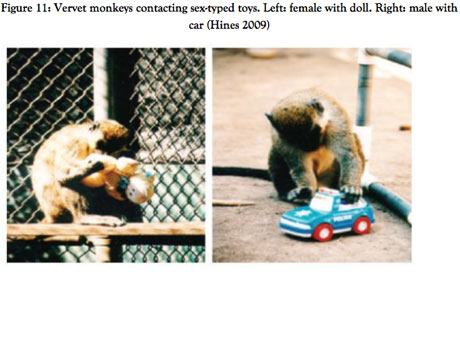
Hines's research, the most up to date, did however identify a gendered divide in the preference for toys. Although not a strict rule, boys were more likely to look at cars and girls at dolls. Previous studies have found that this not only relates to the gender of children but their exposure to androgen ("male" hormones) in the womb. This American research even showed that there is asimilar gendered preference for toys in monkeys leading some to conclude that children are born with gendered tastes in toys.
However, Hines's research also identified that at the age of 12 months, boys and girls' preference for dolls was similar (57.2% of girls looked at the dolls compared with 56.4% of boys). By 24 months boys had shifted towards the car image (52.7% of girls and 47.9% of boys looked at the doll first). This, Hines suggests, adds evidence to the argument that part of toy taste is acquired rather innate. She writes:
The current study adds to growing evidence that infants younger than two years of age display sex-typed toy preferences, with boys showing more interest than girls do in cars, and girls showing more interest than boys do in dolls. Within sex analyses found that the female preference for dolls over cars begins as early as 12 months of age, whereas boys of this age also prefer dolls to cars. The male preference for cars over dolls, or avoidance of dolls, emerges later, suggesting that socialisation or cognitive development, rather than inborn factors, causes the male avoidance of feminine toys.
I think those figures from the Hines study are also interesting because they are not conclusive – at the age of two the gender divide is still not far off 50/50 - hardly figures to support an entire retail industry's marketing tactics.
I'm going to talk to some of the researchers in this area but does anyone have any other evidence to add to this? Get in touch below the line, email your me atpolly.curtis@guardian.co.uk or tweet @pollycurtis.
12.23pm: Dr Qazi Rahman, a psychologist who runs the psychology programme at Queen Mary University of London (which he describes as "strongly biological in its analysis of all aspects of human nature"), has written in with what is a pretty neat summary of the evidence on colour and toy preference. He reaches a similar conclusion to Hines:
I think the literature is erring on the side of no robust sex differences in either adults or children (by "robust" I mean the same finding is replicable) ...  However, there are sex differences in other types of cognitive abilities and psychological behaviours like engaging in rough-and-tumble play, certain types of spatial skills (but not all), and play preferences for objects with moving parts versus those that indicate some kind of individual (eg crudely - trucks versus dolls).  Some say the earliest you can measure these abilities is in almost newly born infants, others say the tests only work at about two years of age and so on. So developing good psychological tests to use in youngsters might be a limitation in some of the science.
I think a good test of these preferences is to examine them in kids of are gender nonconforming at a young age compared to children who are gender conforming.  We know that gay men report have strong gender-nonconforming play interests as children.
Rahman says that while the evidence is pretty conclusive on colour preferences, he thinks it is more strongly weighted in favour of there being some kind of innate preference for certain toys and games amongst boys.
In this Rahman disagrees with the psychologist Cordelia Fine, who argues in her book that almost all aspects of gender is acquired. I've had several messages form readers below the line and by email recommending her book,Delusions of Gender. My colleague Amelia Hill summarised it very well here last year. I've emailed Fine (in Australia) and am hoping I'll be able to speak with her about our specific question later.
I've also been recommended Pink Brain, Blue Brain, by the American neuroscientist Lise Eliot. She argues that any small differences between girls and boys are amplified in their socialisation and hard-wired into their brains this way. This is from the summary on her website:
In the past decade, we've heard a lot about the innate differences between males and females. So we've come to accept that boys can't focus in a classroom and girls are obsessed with relationships: "That's just the way they're built." In Pink Brain, Blue Brain, neuroscientist Lise Eliot turns that thinking on its head. Calling on years of exhaustive research and her own work in the field of neuroplasticity, Eliot argues that infant brains are so malleable that small differences at birth become amplified over time, as parents, teachers, peers — and the culture at large — unwittingly reinforce gender stereotypes. Children themselves exacerbate the differences by playing to their modest strengths. They constantly exercise those "ball-throwing" or "doll-cuddling" circuits, rarely straying from their comfort zones.
There's a fantastic debate going on below the line with plenty of suggestions of good evidence for me to follow. There are two areas I want to follow and wonder if anyone can help find evidence of: have there been international comparisons that might prove, or not, that colour preferences are culturally determined?
Can anyone recommend people - academics of people who work in marketing - who can talk to me about how toy companies market to children?
1.35pm: In the nature v nurture argument about children's preferences for different toys, research in monkeys (mentioned above) has bolstered those who believe we're born with feminine or masculine preferences and mystified sceptics. American researchers in this paper (pdf), showed that monkeys have similar instincts to those observed in small children. The abstract of paper says:
We compared the interactions of 34 rhesus monkeys, living within a 135 monkey troop, with human wheeled toys and plush toys. Male monkeys, like boys, showed consistent and strong preferences for wheeled toys, while female monkeys, like girls, showed greater variability in preferences. Thus, the magnitude of preference for wheeled over plush toys differed significantly between males and females. The similarities to human findings demonstrate that such preferences can develop without explicit gendered socialisation. We offer the hypothesis that toy preferences reflect hormonally influenced behavioural and cognitive biases which are sculpted by social processes into the sex differences seen in monkeys and humans.
Dr Stuart Basten, from the department of social policy and intervention at the University of Oxford has just sent in his paper analysing toy preference and gender, which reaches a similar conclusion (pdf).
As in most of the working papers in the series, the over-riding conclusion of this piece is that both biological and social processes play a crucial role in shaping children's interactions with toys which, in turn, has been found to significantly impact upon an individual's gendered scheme and progression.
Basten also includes this picture from the monkey study, which I quite like.
Monkeys playing with toysMonkeys playing with toys in 2009 Hines study
2.16pm: I asked earlier whether anyone knew of any international evidence that different boys and girls in different cultures have different tastes in colours and toys. I was interested because I'm always struck when I visit my daughter's cousins in Sweden that children's clothing in particular is much less gendered than in England. Babies tend to wear more uni-sex bright patterns than pale pink and blues. Dr Rahman (see above) came back with this small study which showed differences between British born and Chinese born men and women. It says:
We find robust sex differences in hue preference: the average female strongly prefers pinks and lilacs, while the average male has less marked preferences; both 'dislike' yellow - greens. These differences are more marked for the UK-born sub-sample (36 females; 27 males) than for the China-born one (18 females; 19 males). UK males prefer darker and less saturated colours, while UK females prefer brighter and more saturated colours. In the China-born sub-sample, both sexes prefer brighter colours, and the males prefer more saturated colours.
(Unsaturated colours are "pure" colours; for example, an unsaturated red would be a stop sign and a saturated one might be a burgundy.)
The study is small, and the Chinese born cohort were actually students at British universities, so the study is perhaps a bit limited. But it does suggest that there are cultural differences between countries as well as over time (earlier we mentioned the fact that in the early 20th century the blue/pink trend was reversed).
2.53pm: I've not been able to make contact with Cordelia Fine, who wrote the book Delusions of Gender, which so many of you have recommended to me via Twitter, email and below the line.
From what I can see she didn't specifically look at the issues of colour and toy choice, but more broadly at arguments that men and women are hardwired to have different personality traits. According to the various reviews and interviews with her about the book, she systematically picks apart the existing science about the brain to dispel what she believes is a growing assumption that men and women are wired differently from birth. She argues that almost all of our characteristics are learnt. She said in an interview with the Guardian last year:
There are sex differences in the brain. There are also large sex differences in who does what and who achieves what. It would make sense if these facts were connected in some way, and perhaps they are. But when we follow the trail of contemporary science we discover a surprising number of gaps, assumptions, inconsistencies, poor methodologies and leaps of faith.
The article went on:
Fine agrees that there are differences between men and women's brains. The male brain is, on average, about 8% larger. A small group of cells in the hypothalamus is bigger in men. However, "it's not known what this little group of cells does," she says. "It may have a physiological rather than psychological function."
As for other claimed differences, she argues, there might be "engineering" reasons for larger brains to be arranged differently from smaller brains.
She also points out that, because of the brain's plasticity in responding to the world around it, differences in male and female brains can't just be chalked up to congenital biological differences. "The circuits of your brain are a product of your physical, social and cultural environment, your behaviour and your thoughts," she says. "Gender as a social phenomenon is part of our neural circuitry."

Verdict

There is no scientific evidence that boys prefer blue and girls prefer pink. Up until the early 20th century the trend was the opposite and baby boys were dressed in pink and girls in blue. There are also some - small - studies suggesting that adults of different cultures have different tastes in colours. It's clear that colour preference is learnt rather than innate.
There is some evidence that boys are in some way hardwired to express an early interest in "rough and tumble" games and toys with moving parts and girls to prefer dolls and role-play games, but this is not conclusive because the studies are often in babies and small toddlers and therefore inevitably difficult to analyse. The differences that have been found are also often not very big. At two years, for example, 52.7% of girls in one study chose to look at a dolls face over a car, compared with 47.9%; not a huge variation.
Those who argue that there is some sort of genetic or hormonal trigger that sets a gender divide in toy preference cite studies that show that girls who are overexposed to male hormones in the womb are more likely to like "boys' toys" and others that show monkeys of different sexes following similar patterns to children. This area is fiercely contested. However, even those who argue that there are innate factors emphasis that these are small and amplified by the characteristics children acquire from birth, which in turn differentiate and shape children's brains so that boys' and girls' brains might well look different.
3.34pm: We haven't in this blog been able to question any of the marketing techniques that might exploit - or some suggest help create - social norms about colour and choices in toys. My colleague Jon Henley wrote a very good feature on this subject in 2009, in which he was able to look more at the marketing practices. It includes the first reference that I can find in this context to the "gender apartheid" in children's toys. It was adopted by Ed Mayo of Co-operatives UK, former head of the National Consumer Council and co-author ofConsumer Kids: How Big Business Is Grooming Our Children for Profit. Mayo was quoted as saying:
It's staggering, the extent to which parents are now having to trade off their own values against the commercial interest of companies. Today's marketing assigns simple and very separate roles to boys and girls, and whips up peer pressure to police the difference.
The feature goes on:
All this happened, Mayo argues, "with the emergence of a children's market, and the need to differentiate between boys and girls: the need to make more money, basically. This isn't something that's genetically hard-wired, it's culturally created, and therefore it should be open to question." The children's market has now reached the stage, he says, where "it's no exaggeration to talk of a gender apartheid."
My colleague Jane Martinson, the Guardian's women's editor, has also blogged on this here pointing out the Early Learning Centre doctor's costume labelled as being for boys on the Ocado website.
Earlier this year the government's Bailey review of the commercialisation and sexualisation of childhood looked briefly at the issue of gender stereotyping. The full report (pdf) says that gender stereotyping was raised regularly as a concern among parents. It draws on previous government research which found "no strong evidence that gender stereotyping in marketing or products influences children's behaviour significantly, relative to other factors" and concludes that retailers are simply responding to demand:
There is a popularly held view that girls and boys play with stereotypical toys because they learn to see this as appropriate for their sex. This is contested territory: others argue there is greater evidence now of there being innate gender differences so that a desire to play with one kind of toy over another is at least as much about biological drivers as with socialisation and has to do with a normal, healthy development of gender identity (Buckingham, Willett, Bragg and Russell, 2010). What is not in doubt is that the commercial world provides plenty of reinforcement of gender stereotypes and is likely to do so for as long as there is customer demand.
It's worth reading this blog (scroll down to the entry Sexualisation and Gender stereotyping? One response to the Bailey review) by Meg Barker, an Open University psychologist, in which she questions both this conclusion and the review's decision to prioritise the sexualisation of children's merchandising over the whole issue of gender despite both being raised as a concern of parents. Thanks to @AlisonAfra for recommending this blog via twitter.
Below the line @trefusis makes the case that the gender factor helps expand the children's market:
Live blog: Twitter
Of course, if we adhere to gender categories with toys and colour of accessories, then parents whose second child is a different gender from the first can be sold a whole new set of things. It makes business sense for shops to promote gender apartheid - in fact, the more difficult it is to find neutral things, the better. They don't want us to be able to hand things down.
I think the whole role of marketing to children, including the claims made in the Bailey report, might be a good subject for Reality check to return to.

2013年5月12日日曜日

from the book PINK AND BLUE WORLD


from the book PINK AND BLUE WORLD
Gender Stereotypes and Their Consequences
Cviková, Jana – Juráňová, Jana, eds.
Aspekt and Citizen and Democracy 2003
1st edition
292 pages
English translation by Eva Riečanská
Jana Cviková

One Is Not Born a Woman or a Man
Sex and Gender
One is not born a woman, but becomes one
Simone de Beauvoir
One is not born a woman? Or a man? Is that really so? The first thing we learn after a baby is
born is her sex. Surely, the words “it’s a boy” or “it’s a girl” are statements naming some
biological reality that is usually beyond any doubt. But that is not the end of the story. The
verdict “it’s a boy” or “it’s a girl” does not concern only biological characteristics. It also
decides about the future direction of the social development of the baby as a girl and woman
or as a boy and man will head. On the one hand, the statement names the biological sex, on
the other hand it implies the gender of a person as a set of social roles and cultural norms and
expectations related to femininity and masculinity.
Gender Difference
So, is it a boy or a girl? Hansel or Gretel? Dominic or Dominique? Kim or Kim? Beautiful
Day or Sitting Bull? Stupid Hans or Cinderella?
Babies get their names so that they will not get lost in the world; so that they can become part
of human society. But there is more to a name: in most societies the name indicates the sex of
its bearer and becomes important in gender specific socialization of a child. The child is not
given just any kind of a name but a name that clearly denotes its sex. Rules about reading
names as male and female differ in different cultures. The name is a complicated cultural
construct and as such it is close to gender. In our society, naming rules are also regulated by
the law. Laws and regulations require the congruence of sex and gender and they take for
granted that sex is unambiguous (which, by the way, in a small percentage of babies is not a
clear biological given, and their parents have to choose: either a boy or a girl).
It seems that in order to run smoothly, our society needs to clearly and unequivocally
distinguish between the sexes and maintain the social distinctions between femininity and
masculinity via deliberate (e.g. the law) and unintentional (e.g. fairy tales) mechanisms. This
distinction is substantiated by the role of women and men in reproductive processes, but it
does not involve just biological characteristics: different biological functions or capacities of
the female and male body are the starting point for other imperative differences regarding the
way of life, characteristics, appearance and behaviour. At present, the definition of the role of
women and men, and the division of labour between genders is closely related to the
understanding of pregnancy and childbirth as the only woman’s predestination. In spite of
changed social circumstances of reproduction, gender differentiation, and considerable
polarization of interests, activities and personalities of women and men prevail in most areas of our life; but that does not mean that these divisions are “natural”. The relationship between
women and men, based chiefly on concrete – and variable – norms of the gender role, differs
in different societies and time periods. It is not “natural”, but historically, socially and broadly
speaking culturally determined.
Legitimisation of Inequality
We know the rhetoric of inequality between women and men in its past – socialist – and
present-day variation. We have experiences with changes in gender relations in both the
public and private sphere but also with cemented prejudice about changeless femininity and
masculinity. Where is this contradiction coming from and what purpose does it serve?
We can use arguments about tradition, nature or natural order of the world and hence confirm
the domination of the male way of seeing,1
 taking for granted the existing power relations,
and believe that they are immutable. Or we can critically look at the current constructs of
masculinity and femininity, on the role of gender specific socialization of men and women in
maintain and confirming of inequality in our society – and thus open up the space for changes
that can be effectively started in school.
The conviction that the dissimilarity of the female and male role naturally follows from their
biological difference is one of the most stable pillars of our culture. Its power is great. It
ignores everything that subverts it – historical, social or psychological facts – and it even
contravene our own experience. Through the use of stereotypes, people around us daily
convince us about the “truthfulness” of the statement about the strong and weak sex, which
has about as much validity as the statement that women wear skirts and wear men trousers. As
a consequence of the belief in natural gender difference we often forget what women and men
as human beings have in common, what unites them. And although the biological sex is not
completely separable from cultural gender, and gender stereotypes “hinge” on biological sex,
the variability of women and men within their own sex/gender is much more pronounced than
the difference between women and men as groups.
Differentiation of sexes and genders is significantly implicated in the arrangement of
relationships between women and men in society, chiefly because it legitimises this
arrangement as natural. The argument about unquestionable validity of natural laws justifies
unequal division of labour between women and men, in which women do most of unpaid or
worse paid work. It also justifies unequal distribution of power between women and men –
the power to decide about themselves and the world that surrounds them.
The belief that there is some generally valid and correct “masculinity” and “femininity” puts
women and men into a narrow straightjacket of prescribed roles that do not correspond with
real needs of partnership and cooperation between people in society a do not respect the
individuality of women and men as unique human beings. Therefore, in our society the words
“a boy” or a “girl” is often a verdict putting the baby on a track leading to either the pink of
the blue world.
Two Waves of Feminism2
Already in the 18th and 19th century, critically thinking women and men questioned the
ideology of immutability of the predestined female and male role. Mary Wollstonecraft,
Olympe de Gouges, Stuart Mill, the suffragists, Rosa Mayreder, Elena Maróthy-Šoltésová and others mostly critiqued the “female nature” that should prevent women from getting education
and the right to vote. The first wave of feminism in the 19th century and the beginning of the
20th century focused mostly on women’s suffrage.
Nowadays, we take women’s right to vote for granted and we do not give much thought to
whether it is “unwomanly” and whether its exercise – requiring making independent
decisions, seriously violates women’s health or morals (even the contemporary definition of
the “right womanhood” presumes that a woman “doesn’t know what she wants”, “asks other
for directions”, “lets herself being led”, “is dependent”). Or more precisely – we don’t give
too much thought to the active right to vote, but we often and without hesitation comment on
the prescriptive “femininity” of a female politician using stereotypical female attributes.
The first country to grant women the right vote was New Zealand in 1883. In Czechoslovakia,
women gained the right to vote in 1919, in France as late as 1944. The illusion that universal
suffrage would ensure gender equality swiftly dissipated. The French writer and philosopher
Simone de Beauvoir in her iconoclastic book The Second Sex (first published in 1949)
examines deeper roots of women’s subordination from the perspective of concrete family
relations and socialization of girls and boys, as well as from the perspective of transmission of
tradition and knowledge in society as a whole. The formation of a “womanly” passive woman
(“don’t be a tomboy”, “don’t soil you dress”, “be a nice/good girl”) and a “manly” active man
(“boys don’t cry”, “don’t be a sissy”, “ fight with the dragon”) is constantly happening on
several levels: in fairytales a woman will learn that “in order to be happy she must be loved,
and in order to be loved she must wait for her love” (de Beauvoir, published in Slovak:
Aspekt 1/2000). Fairytales, stories and folk songs are filled with Sleeping Beauties,
Cinderellas, stepdaughters, and women who give, wait and suffer. “In songs and fairytales
the young man adventurously sets out to look for a wife. He fights with dragons, wrestles with
giants; she is locked up in a tower, palace, garden, tied to a rock, captured, sleeping – she is
waiting.” (Ibid.). De Beauvoir’s disillusive analysis of prevailing cultural patterns maintaining
a hierarchical relationship between women and men and putting women in the position the
“second” sex caused much furore and countless discussions. The book The Second Sex has
become cult reading for the second wave of feminism. The author in the book summarizes
cultural underpinnings of the female role: "One is not born, but becomes a woman. No
biological, psychological, or economic fate determines the figure that the human female
presents in society: it is civilization as a whole that produces this creature, intermediate
between, male and eunuch, which is described as feminine." (de Beauvoir, in Slovak in :
Aspekt 1/2000.)
The second wave of feminism that started in the USA in the 1960s and in Western Europe in
the 1970s3
 initially focused upon women’s access to paid jobs, reproductive and sexual rights
and health. Later the spectrum of issues broadened: violence against women and children
(esp. the issue of sexualised violence), inadequate representation of women at all decision
making levels, the domination of the “male perspective” and indivisibility of women in
science, research and education, and others.
The feminist movement and thinking was diverse already at its beginning and with the
passage of time it has grown even more pluralistic – therefore it is better to speak about
feminisms (such as ecofeminism, African-American feminism, liberal feminism, socialist
feminism, feminism of gender equality) rather than a singular feminism. These different
feminisms mutually overlap, interlink, and complement each other, but they also fight, negate
and contradict one another. Their common thread, however, is the conviction that women are human beings and therefore they have the duties but also responsibilities and rights of a
human being.
Sex and Gender
In western countries thanks to feminist thinking the distinction between biological sex and
cultural gender has become important part of reflection in science, education and politics esp.
since the 1980s.
Feminist and later gender theories have unmasked the gender blindness of the way of seeing
that used to be regarded as gender neural. It became and more difficult to present the
domination of the male perspective as seemingly gender neutral.
From the gender perspective it has become apparent that it is not only the female gender role
but also the male gender role that is affected by ideas or even the dictate of a concrete society
in a concrete time and space. Gender-aware observations and analyses of social structures
have shown that problematic it is not only obviously disadvantaged “femininity“, the critique
of which already has a long tradition, but also “masculinity“ distancing men from
relationships and their responsibility for them. No matter how diverse the gender role when
performed by individual women and men may be it is not primarily an individual matter. Its
formation is influenced by stereotypical ideas about femininity and masculinity surrounding
us and creating the setting for its performance. The stereotypes condition gender relations that
are constructed on the basis of conventional perceptions, cultural patterns and ideologies
piling up around the concept of “true“ femininity and masculinity. The symbolic order based
on complete difference and mutual “exclusivity“ of the two sexes – as we can see it in the
expression “the opposite sex” implying that the man should be the opposite of the woman and
vice versa, is not limited to the mere statement about otherness of the sexes. The opposition of
sexes is linked to evaluation of this otherness, to creation of hierarchies, to assigning of
functions, and to formation of stereotypical ideas.
The Rules of Femininity and Masculinity
No matter what her individual personality and life circumstances may be, each concrete girl or
woman is confronted with the basic rule of femininity: „in no case should a woman want to be
like a man“. This rule creates a set of expectations that can be summed up by statements such
as “she is mindful that a man doesn’t feel week or inferior“, “she finds her self-fulfilment in
caring for others“, “she is sensitive, gentle, compliant“ or “she tolerates much and forgives
a lot“. The main rule of masculinity - “since a man is not a woman he never does what
a woman does“ – confronts a boy, irrespective of his individual personality and life
circumstances, with expectations that cold be summed up by statements such as “he wants to
be stronger, smarter and wants to earn more money“, “he finds his self-fulfilment in
professional success“, “he is tough, never showing his feelings“ or “he tolerates nothing and
forgives nothing“.
When comparing these expectations still marked by broadly accepted stereotypical ideas
about women and men, one must ask whether it is possible for these women and men to live
in a partnership based on fair division of rights and responsibilities in both the private and
public life. They will not get away easily with breaking the basic rules – they will suffer
ridicule (comedians who ridicule women or “unmanly“ men are commonly rewarded by
appreciative bursts of laughter from their audience) and scorn (“masculine“ women or
‘effeminate“ men are often targets of cruel despise). This general agreement about what is funny and despicable attests to general
comprehensibility of gender stereotypes in our culture, and indicates what they are “good
for“. They simulate simple orientation in the world: from the perspective of short-term
effectiveness it is expedient to use what appears to us as culturally obvious. But the question
is: what price do we pay for that.
A stereotype does not have a subject – it is not created and reproduced by someone. It
emerges and is reproduced in the web of expectations and those to whom stereotypes pertain
cannot influence them. Our own stereotypical expectations depend on stereotypical
expectations of others and this creates a vicious circle. For instance, from the stereotype that
„women are mothers“ follows the stereotype that „women want to take over exclusive
responsibility of childcare“, and from that follows the stereotype that „women seek out parttime jobs“, which in turn discriminates against all women on the labour market. Facing this
dead-end situation, people that are discriminated against usually conform to the stereotype
that lies at the root of the discriminatory situation. The impossibility to escape, forces them to
resign (McKinnon quoted in Holzleithner 2003).
The ubiquitous implicit gender hierarchy daily places us inside the limits of the stereotypical
gender role. As it seems, for the sake of social stability it is simpler to maintain the social
order based of an unjust and distorting stereotype rather than to constantly negotiate the social
order based on open communication and mutual respect.
However, the stereotypical understanding of the female and male role that would confirm and
maintain gender inequality is shaking. Its presence in the real life is not as frequent and firm
as the ideological constructs in advertising, the media, politics, fairytales, literature or text
books are trying to convince us. On the other hand, stereotypical constructs influencing social
values are arduously resisting verbal political proclamations about equality between women
and men, provisions on gender equality in the Constitution of the Slovak republic, laws
prohibiting discrimination on the basis of sex and gender in employment, as well as the reality
of changing roles of concrete women and concrete men.
The Pink and Blue Imperative.
The fixed idea about “inborn“ femininity and masculinity glosses over the fact that children
enter a micro and macro-cosmos formed by the cultural pattern of gender duality and that in
each moment of their lives the socialization of a girl or boy takes place in this divided and
hierarchically organized world. Children enter a pre-structured world of expectations, hopes,
limits and colours, in which gender as a social category plays a very important role. In our
cultural setting, the girl is surrounded by the pink imperative and the boy the blue imperative.
The attribution of gender roles happens by means of communication, evaluation, clothing,
selection of toys and games. The decision between a doll and a car does not follow from the
biological sex of the baby but from the social evaluation of the toy as either appropriate or
inapposite for a girl or a boy. If we, as parents, decide to disrupt this strict division of toys and
give a boy, for instance, a doll to play with we are aware of the fact that our decision goes
against conventions and that it is more than likely that reactions to a boy playing with a doll
will be different from the reactions to a girl. The children are also likely to receive different
instructions on how to handle the doll. Usually no one rushes in to remind a boy playing with
a doll about how to caress it, and he will not be immediately called “a father“. People around him will not get excited over his “inborn fatherly instinct“. On the contrary, when a girl is
playing with a doll the instructions and appreciation of the adults usually emphasize her
presumed future motherhood.
The play of both children is seemingly the same - they are playing with the same toy, but the
cultural framework of their play is gender specific. As the author of one the basic studies
about gender stereotypical socialization approaches Elena Gianini Belotti points out: “A child
has an inborn capacity to play, but the rules and objects are undoubtedly the product of
culture.“ (Belotti, in: Aspekt1/2000.)
The repertoire of toys is just seemingly broad. Children select their toys and games
independently, but they also react to what we offer them. And this offer is already a selection
from the existing choice.
An important factor creating the existing offer and guiding parents’ choices is advertising.
Advertising works with stereotypes – with their confirmation and subversion. In Slovakia, in
toy advertising still prevails uncritical exploitation of gender stereotypes, which leads to their
further reproduction even reinforcement. The colour design of ads copies the gender
stereotypical rules of the pink and blue world.
Let us demonstrate how this functions on concrete advertising leaflets:
For babies of up to 3 years many toys are still gender neutral. This may not be true for all
toys, but it is true for animals and building blocks. Under the slogan “The best for the
youngest”, the leaflet offers toys “appropriate” for both girls and boys – it does not
discriminate on the basis of their gender. The prevailing yellow colour with no strict gender
coding is used to signal openness.
The best for the youngest
The pink and blue worlds of the other pages of the leaflet speak about different demarcation
of the space for girls and boys – girls belong to the household (the private sphere), while boys
belong to the world (the public sphere); the girls should be practical while the boys should be
creative, and the like. While the girls depicted on the pink page as small mothers (Let’s pretend we are moms and
housewives) are taking care of dolls, carrying out household chores and taking care of
themselves to be pretty, the boys on the blue page are receiving their invitation to the world of
creativity and knowledge.
Let’s pretend we are moms and housewives
For young scientists and constructors
While the girls on the pink page get the message that they are little dressy girls and the best
jobs for them are a seamstress, hair dresser or beautician, the boys on the opposite blue page
are setting out to conquer the world. For small adventurers
For small seamstresses and dressy girls
Another advertising leaflet seemingly introduces us to the world of a family, as if the offer
from the private sphere “to be like my mom” or “to be like my dad” was equally addressing
both girls and boys. At a closer look, however, the situation appears to be very different: the
girl on the pink page under the slogan “I want to be like my mom” is doing house chores and
taking care of dolls. The boy, who wants to be “like his dad” identifies himself with action
figures of superheroes. …and I want to be like my father
The identification offer for girls is clear: a girl = a future mother. Directly linked to
motherhood is the female obligation to take care of their appearance and household. Given the
high female unemployment rate in our country it is remarkable that advertising based on such
reduction of the female role actually works. Pink departments of toy stores make profit;
therefore our society seems to prefer this division of labour - irrespective of the “equality of
opportunities”.
The identification offer for boys is much more diverse: a boy = a future professional (or
conqueror), but not a future father. The action figures of superheroes whose image is evoked
as a paternal model can hardly be considered to be preparation for fatherhood.
Nobody prevents girls and boys from becoming successful professionals or good fathers,
respectively, but nobody supports them to become so either. On the contrary, all signals are
telling them: you do not live in the same world.
At the beginning, the inquiry into mechanisms of gender stereotypes was based on the idea of
female gender stereotypical socialization as limiting and constraining (Scheu in: Aspekt1/2000), which was understandable given the tangible discrimination against women that had
been the first impulse for critical approach to traditional roles. This approach considered the
male role - in contrast to the female role, to be the source of social privilege but also of higher
personal satisfaction. Later it became apparent that also men are constrained by gender
stereotypes (see e.g. Bernardová — Schlaferová 1997).
Striking about the given advertisements examples is the fact that girls can at least partly find
some reality of the life of their mothers and other women in the presented patterns. That is
much harder for boys: the father is absent and not all men they know are scientists or
conquerors of new planets.
Games and toys do not exist in the vacuum of arbitrariness – they are socially embedded and
serve to put girls and boys on the track of their conventional social role. When children react
in accordance with conventional expectations we consider that a “mollifying symptom of
normality” (Belotti in: Aspekt 1/2000). The selection of toys attests to the fact that children
very early know what behaviour is rewarded and what behaviour is regarded as gender
appropriate. The fact that differentiation of toys into intended for boy and for girls grows with
children’s age points to very strong cultural influences (Oakley 2000).
Gender Relations in Textbooks
„If children were getting all information on gender relations in the grown-up world only from
their textbooks they wouldn’t have any idea that they are living in a country in which gender
equality is guaranteed by the constitution,“ comments bitterly on her analysis of elementary
education textbooks the Polish author Anna Golnikowa.
In school besides official explicit curriculum we present to children also hidden curriculum.
This curriculum often reinforces existing gender stereotypes esp. gender division of labour.
The choice of life paths of boys and girls differs considerably. Rigid gender stereotypes are
not limited just to advertising as a symbol of superficial consumerism but they also dominate
in textbooks that are a symbol of generational transmission of knowledge.
When going through the pages of ABC books, primers and readers for first classes of
elementary schools we often come across stereotypical division of labour in the family: The father is reading a newspaper
The mother is pushing a stroller with a baby.
Boba and Biba have new dolls.
Biba is pushing a stroller with her doll.
But the doll is not sleeping. She is crying: Ma-ma!
Boba is carrying her doll.
My doll is barefoot.
I will give her blue slippers.
Biba and Boba are little moms.
They are playing with their dolls.
Just like advertising, also textbooks prepare girls for their maternal role. Boys are reminded of
their paternal role only in passing, in addition to other, more important things – such as a
motorcycle or football. In textbooks, boys and men represent people as such, they are
universal representatives of the humankind; girls and women are often just invisibly included.
Textbooks bring the idea about incompatibility of the image of the real man (The proper man
is interested in football) and the father who shares a common world with his children. The
image of the mother is reduced to the image of a servant as if the real woman was just a
performer of household chores. These images in textbooks have survived socialist
emancipation of women and they are still alive irrespective of the fact that their real life
validity for the whole population of Slovakia is at best dubious. This approach encodes female
fear of the public space and male incompetence in the private one, which has implications not
only for division labour in childcare and household care but also in the public life.
Examples of texts in readers:
Mother is washing laundry in a washing machine (…) She washes it and hangs it. The
washing machine is mom’s good helper. She is putting the laundry in the washing machine.
Mom was playing with my new shoe and Dad’s pen. I don’t know why - she is a gown-up.
Even dad didn’t know. He asked mom: What are you doing?
I’m writing down our address so that people will know where to bring back your daughter is
she got lost at the football match, replied Mom.
But what do about it? Textbooks are very important teaching aids – should we throw all of
them away? We should not but we can speak with children about the images of women and men in
textbook and compare them with the diversity of reality. We can try to notice stereotypes in
our own approach to children and to curriculum and strive for a gender sensitive approach.
We can use subversive texts, or non-traditional interpretations of fairytales. Together with
children, we can learn to critically perceive the “eternal” and “only” truths.
What Society Does Not Know
The school and people in it are part of the whole society; therefore the school will not teach
what society does not know. The process of transformation of our society has brought about
diversification. Sometimes it seems that society, or its parts, do already know, but the school
has not learned yet. In the 1990s non-governmental women’s organizations were springing up
and they were gradually opening up themes related to women’s human rights and especially
to the unequal status of women and men. Feminist and gender studies programmes started to
develop and book were published.4
 Mainly in relation to the EU accession process, emerged
also the first official instruments to foster equal opportunities of women and men in society
(Department of Equal Opportunities at the Ministry of Labour, Social Affairs and Family and
the Conception of Equal Opportunities for Women and Men). The Conception approved by
the Government of the Slovak republic contains concrete provisions related to education such
as modification of the curriculum to include gender equality and non-discrimination on the
basis of gender and sex and elimination of gender stereotypes. These provisions are in line
with the Convention on the Elimination of All Forms of Discrimination against Women
(CEDAW) that is binding also for the Slovak Republic. From the educational perspective
especially relevant is namely article 5 in which states committed themselves to taking all
appropriate measures to modify the social and cultural patterns of conduct of men and
women, with a view to achieving the elimination of prejudices and customary and all other
practices which are based on the idea of the inferiority or the superiority of either of the sexes
or on stereotyped roles for men and women; and also point (c) of Article 10 that commits the
states to the elimination of any stereotyped concept of the roles of men and women at all
levels and in all forms of education, in particular, by the revision of textbooks and school
programmes and the adaptation of teaching methods;
This means that the school will learn several basic things:
- Biological sex is determined by nature and its principles before the baby is born; at the
latest in the moment of childbirth the baby’s gender starts to shape;
- Certain differences based on biological predispositions do exist but they do not justify the
ideas about natural existence of the female and male role as given and the only correct
ones, and do not justify unequal social status of women and men.
- The process of gender specific socialization of girls and boys has many layers and is
taking place constantly; it is resistant to attempts at its conscious control. However,
teachers – when creating the offer of co-ordinates of orientation and identification for their
pupils, have the power to decide whether the school will uncritically participate in the
reinforcement and reproduction of gender stereotypes or whether it will question them,
uncover their meanings and open up new spaces for both girls and boys to shape their own
forms of femininity and masculinity.
And that also means that through reflection on their own gender role and stereotypical images
of women and men, all “school goers” will get a change of more self-conscious orientation in
the world. References:
Feminist cultural magazine Aspekt, especially the issue „One is Not Born a Woman“ 1/2000.
Beauvoir, Simone de: Druhé pohlavie. In: Aspekt 1/2000. (The Second Sex)
Belotti, Elena Gianini: Hra, hračky a detská literatúra In: Aspekt 1/2000. (Games, Toys and
Children’s Literature)
Bernardová, Cheryl — Schlaferová, Edit: Matky dělají muže. Jak dospívají synové. Pragma,
Praha 1997. (Sons are Made by Mothers, How Sons Grow Up)
Golnikowa, Anna: Utrwalanie tradycyjnych ról płciowych przez szkole. In: Pełnym Głosem
3/1995. eFKa, Krakov.
Hevier, Daniel: Strašidelník. Kniha pre (ne)bojácne deti. Aspekt, Bratislava 1998.
Holzleithner, Elisabeth: Recht Macht Geschlecht. Legal Gender Studies. Eine Einführung.
WUV Universitätsverlag, Viedeň 2002.
Juráňová, Jana: Iba baba. Aspekt, Bratislava 1999.
Oakleyová, Ann: Pohlaví, gender a společnost. Portál, Praha 2000. (Sex, Gender and Society)
Scheu, Ursula: Nerodíme sa ako dievčatá, urobia nás nimi. In: Aspekt 1/2000. (We are Not
Born Girls, They Make Us Be Them)
Endnotes:
1
The “male” way of seeing, in this respect, does not denote concrete individual perception of a male human
being or a concrete man, but understanding and interpretation of things from the perspective of the dominant
social status of men. This way of seeing regards the man as the universal representative of the humankind.
2
We use the plural form of the word feminism to emphasize the fact that it is a very diverse social and ideational
movement.
3
 In our country we can speak about the second wave of feminism only after the year 1989. Since its beginning it
has had a different course then in the USA and the countries of western Europe but it has drawn inspiration from
their experience and theoretical reflection. At first, it was mainly focused on educational and publication
activities (the feminist cultural magazine Aspekt, the Centre for Gender Studies at Faculty of Philosophy,
Comenius University in Bratislava) and later also on human rights activities (Piata žena/The Fifth Women –
violence against women, Možnosť voľby/Pro Choice – women’s reproductive rights).
4
 The first steps were the Lecture Series in Feminist Philosophy at the Faculty of Philosophy Comenius
University in Bratislava and the feminist cultural magazine Aspekt in Bratislava. You can find more information
on publications at www.aspekt.sk.